creativity· ·7 min read
How I use Jev to resolve ambiguity in creative apps
Adding decision model "gut checks" to the data processing pipeline, in order to make unique artifacts for web app users.

TypeSafe's Jev is a decision model that "achieves similar levels of intelligence on System One tasks compared to existing LLMs, while being two orders of magnitude faster and more efficient." (Yes, TypeSafe is referencing Kahneman.) Correspondingly, the API is pretty cheap.
I was intrigued by the ability to add "gut checks" to data processing. Jev inspired various copycats that I haven't tried, so I have no opinion on the merits of TypeSafe's implementation versus competitors. But I do have an opinion on Jev qua the "decision model" modality: I like this tool for crafting creative apps that produce a unique artifact for each user.
I've made four web apps that rely on Jev. Granted, Claude did all the coding. So I asked Claude to summarize how Jev contributes to the functionality of each app. The output is lightly edited for clarity, but to be transparent, Claude wrote 95% of the following rundown.
Which is fitting! Because Claude is the one who actually orchestrated everything. I merely came up with the concepts and made the artistic decisions 😝 I'm the proverbial "ideas guy," and Claude is the beleaguered engineer. Well... I also bankroll the server. And TwitterAPI.io usage, etc. (Plz use my affiliate link and earn me some credits.)
It's totally possible that there are better ways to approach things. Let me know if you have an improvement to suggest! Heck, open a pull request!
Autozine

Make a zine from a given X user's posts, accompanied by public domain art and quotations. Jev directs the zine composition based on editorial guidelines.
- Suitability evaluation (yes/no). Jev answers three questions per X post, all in one request:
- Too raw: is it about grief, death, abuse, or a similar crisis, where a joke would be callous?
- Stands alone: would a stranger enjoy this post printed with no context?
- Attack: is the post a hostile personal attack?
- Calibration by type of post. Cutoffs were set based on 82 hand-labeled posts: too raw at 0.25 or above, attack at 0.5 or above.
- The bar for whether a post stands alone depends on format (0.3 for plain text, 0.65 for quote posts, 0.4 for image posts).
- A post flagged as too raw can still appear, just never beside a joking definition or quote.
- Picking the spread's look. In the same request, Jev picks:
- a theme (nature, domestic, high techne, or cosmopolitan);
- a typeface voice (bookish, machine, or poster), described by the kind of writing each suits.
- Re-ranking keyword matches. The code identifies posts and entries from The Devil's Dictionary that share a word. Jev then scores each pairing from 0 to 3, from "different sense or poor taste" up to "delightful". Pairs scoring below 2 ("apt") are dropped, and rarer words win ties. For the B-side page spread, the same thing is done with entries from a dream dictionary.
- A fallback when no word matches. Jev scores general definitions or dream readings for how well they suit the page as a whole. The lowest level is "Unkind, bleak, or likely to read as a dig at this person."
- Choosing a quotation. Jev scores about 75 candidate quotes for fit with this person's voice. The levels separate "Generic" from "Feels chosen for this person." A little random jitter breaks near-ties.
- Choosing a picture. Jev scores vintage images by their text descriptions. The final pick is weighted-random among the pictures within 0.3 of the best score, with a penalty for pictures used often, so similar accounts don't all get the same image.
- Plumbing worth mentioning:
- The model version is pinned (
jev-1.14.0) for consistency. - Batch-tagging the corpus offline: Jev puts about 80 passages per request into theme categories.
- Without an API key, everything falls back to keyword rules (
--no-jev). - Token usage is saved in each spread's record.
- Answers are cached on disk by a hash of the request, so re-rendering a spread costs nothing and gives the same result.
- The model version is pinned (
The Last 100 Startups
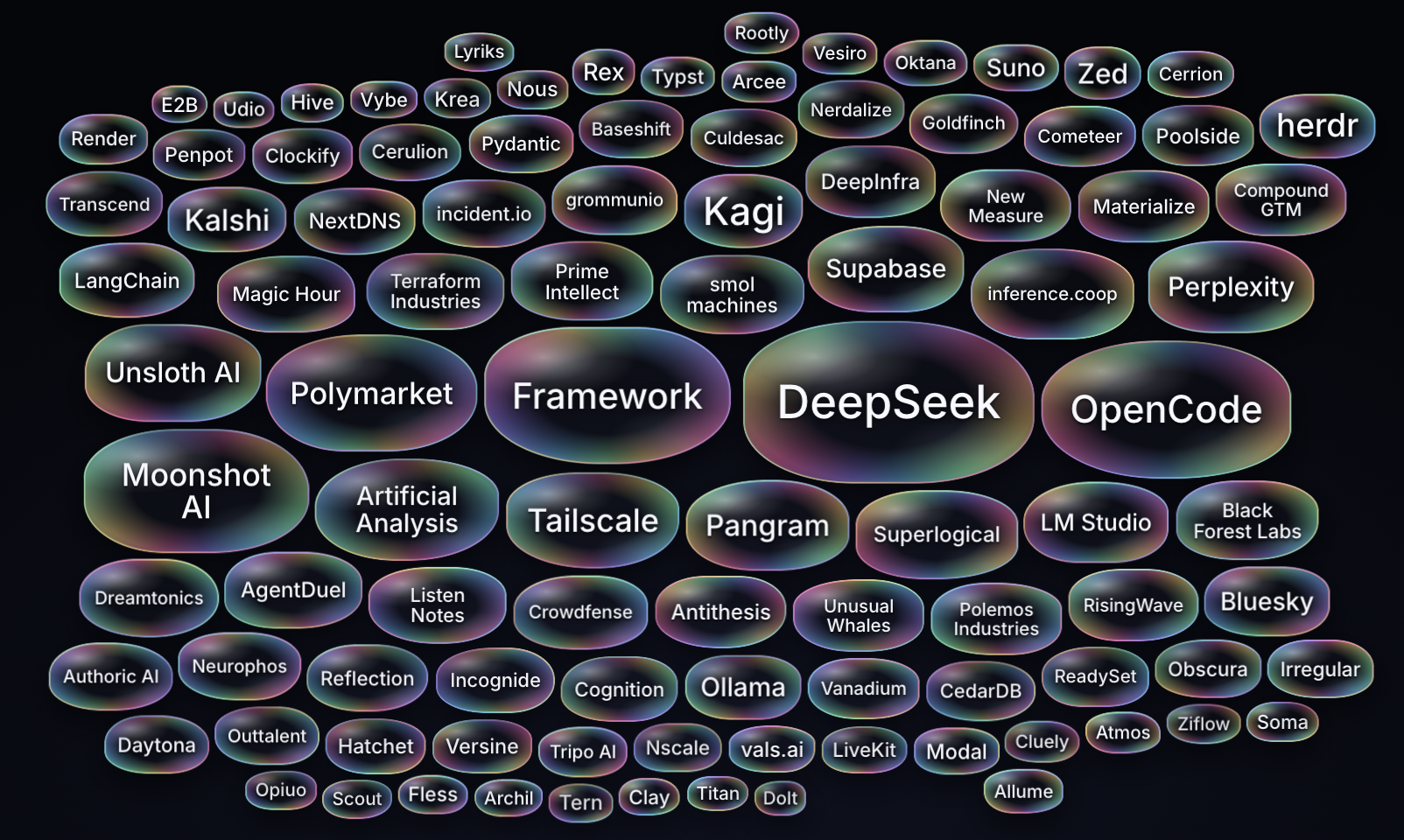
Startups mentioned recently on Hacker News, plus the ability to merge them into satirical "new" companies. Here, Jev is the judge and resolver in a data-cleaning pipeline. A different model (Kimi) handles extraction, web-search summaries, and jokes; Jev makes the decisions.
- Is it a real company? A yes/no answer that rules out open-source projects, AI models named on their own (versus the parent entity), people, and similar.
- Is it a startup? The full written policy is sent as input, along with:
- YC data;
- recent HN mentions;
- facts from a web search, with instructions to prefer them over older knowledge.
The denylist, allowlist, and YC's Acquired/Public/Inactive statuses always override Jev.
- Verifying YC matches. Does a YC company with the same name match how the HN comments use that name? Below 0.5, the YC link and its domain and alias are dropped.
- Re-judging after a web search. Each company is judged again with the new facts. Anything that no longer counts as a startup falls off the board, and the next company moves up.
- Duplicate detection. The code proposes candidate pairs (the same domain name with different endings, like moonshot.cn and moonshot.ai). Jev decides whether they're the same company, merging at 0.7 or above. Jev also picks which name is the company's own name rather than a product's (e.g. "Moonshot AI" not "Kimi").
- Plumbing:
jev-latestrather than a pinned version.- Usage is logged per purpose (
dedupe,verify_yc,judge). - Probabilities are stored in the database (
is_company_p,startup_p), so thresholds live in SQL and can change without asking Jev again. - A looser 0.3 bar marks "company-ish" items in places like the recently-acquired list.
Hallowtide Familiars
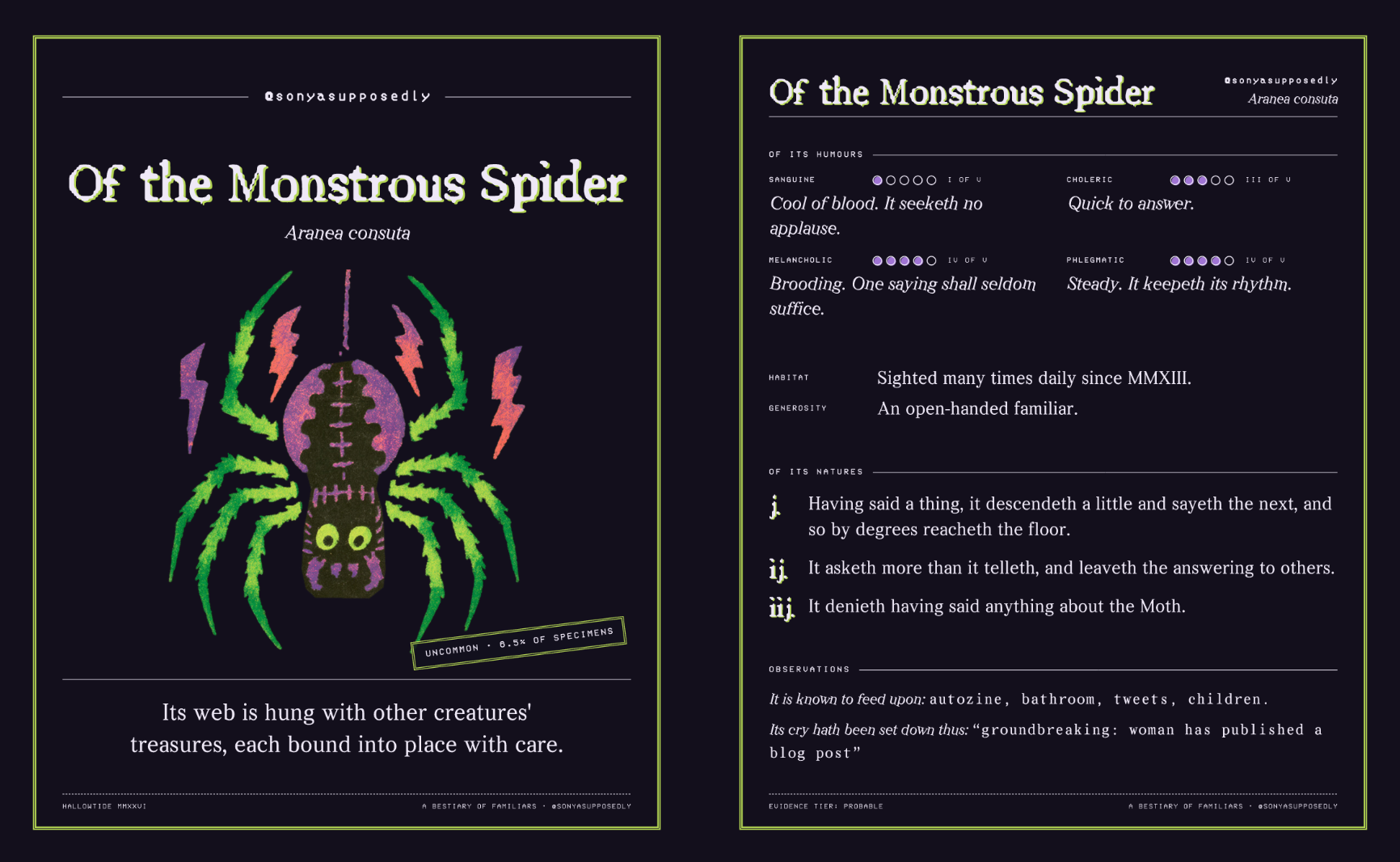
Which classic witch's familiar best suits the user's X account? That determination is made by code, but Jev acts as the content screen. It decides which of the user's own words are okay to print on a public card.
- Screening candidate posts for a quote on the user's card. First, code runs a blocklist, personal-detail patterns (handles, emails, phone numbers, addresses), and font cleanup. Jev's screen comes last. Five yes/no questions:
- distress;
- downcast (the author is feeling low or had a setback);
- hostile;
- "someone in their life" (a private person, or contact details);
- adult.
An item is rejected if any answer is 0.35 or higher, with per-question overrides (distress blocks at 0.2).
- Screening words and phrases. Distinctive terms for the familiar's "diet" and the most-used phrase each get two questions:
- sensitive subject;
- identity or politics.
- A grammar check: "Is this a noun?" Only nouns go into the diet section.
- Plumbing:
- One small request per item, on purpose. Unrelated text in the same request made the answers less accurate. Requests run 8 at a time.
- If any request fails, or an item has no answer, no user text appears on the card at all.
Divination Diagnosis

A quiz that assigns one of 12 divination systems based on someone's X account, along with their answers to multiple-choice questions.
- Placing the account on personality dimensions (scores). Jev rates the X bio plus recent posts on three five-level scales:
- Sharp ↔ Soft,
- Sincere ↔ Ironic
- Mind ↔ Body
Two of these (Ironic and Mind/Body) have no other signal; Jev is the only reader for them.
- Blending Jev with the code's own estimate. Jev's score is compared with the scores of all calibration accounts (by percentile) and weighted by:
- Jev's own confidence;
- a trust factor of 0.6;
- how many posts it saw (full weight at 50).
This is combined with the statistical estimate from the X data. Two sources that agree will raise the confidence level; two that disagree will lower it.
- Behavior "nudges" (yes/no). Two yes/no questions push the result toward certain systems:
- Does the person make bets or give their own numeric odds?
- Do they consult AI chatbots?
A nudge only counts at 0.8 or above, and it scales with how far past 0.8 the answer is. A "no" never pushes the other way.
A link to Polymarket or ChatGPT, or a reply to @grok, counts as a full-strength nudge without asking Jev. Jev handles the fuzzier cases.
- Calibration tooling. A script runs Jev on 666 calibration accounts, then reports:
- the spread of each score and how often each nudge fires;
- how Jev answers on accounts that code already matched exactly;
- latency and token use;
- a
--repeatcheck that answers stay the same on a second ask.
- Plumbing:
- Everything in one request per account. All scores and nudges are asked together. That worked fine for this app.
- The posts sent to Jev are trimmed to stay under the request size limit. Retweets are left out because they aren't the person's own words.
- Jev's answers are saved with the account snapshot for a week, so a retake starts from the same place. The questions and answers still decide the result.
- If Jev can't be reached, the quiz runs on the X signals alone.
- A simulation can compare quiz results with and without Jev's reading.
I hope this was useful! Again, feel free to get in touch with feedback, suggestions... whatever. I'd love to hear what you're working on and get inspiration for the next round of vibecoding! You can email hello@sonya.email, message me on X, or open a PR in one of the repos.